Out for a walk with my new camera. What I'm enjoying the most is the view through the viewfinder. I haven't used a viewfinder for a long time. With the smaller digital cameras, its more natural to hold the camera out in front of you and look at your picture in the viewer on the back of the camera. But with this new Nikon, I'm back to composing my images with the camera up to my eye and looking through the viewfinder. It's the way I always used to use film cameras and it feels very natural.
And sometimes, something comes along that you don't even notice when you take the picture. That's what's happening here. Any ideas on what it might be? Add your ideas in the comments. I might or might not add the answer later, so check the box in the comments if you want to be notified when another comment gets posted.
Tuesday, March 31, 2009


Sunday, March 29, 2009
I feel like a photographer again
I bought myself a new camera - a Nikon D90. That's a picture of it on the right, courtesy of Nikon. (Click on the photo to see a larger image at my Flickr site.) I didn't realize how much I missed using a SLR until now. I knew that using a smaller digital camera wasn't the same as a SLR (I used to have Minolta film cameras, with a large range of lenses.) But since I switched to digital cameras, about 3 or 4 years ago, I've been using a Nikon Coolpix 5000. It was a great camera for its time, but that time was about seven years ago and it was showing its age.
I've been considering a new camera for awhile but I hemmed and hawed over Nikon or Canon, what model, what kind of lens, etc. Usually, I think about it, get ready to make a decision, then just put it off for awhile, which meant that I've just been missing out on a photographer. But after the Northern Voice conference in February, I decided to solve two problems with one solution. I wanted to take more photos and I wanted to increase my blogging. So I decided to start the 1aDay project.
I've been publishing at least a picture every day to my Flickr account and writing a blog post about it. So far, it's worked very well. I started carrying my camera around with me again and I've enjoyed making some nice photos. I've also come up with some topics that I wouldn't have written about otherwise. But as the month went by, the urge to upgrade my camera kept growing.
So on Friday, I asked my Facebook friends what they'd recommend and got a lot of good suggestions - many too expensive for my budget, but all good ideas. It was my wife, Heather, who finally convinced me to just go ahead and get the one I wanted. I realized that I had already made up my mind - so I went out and bought the Nikon D-90. It's a nice camera - not the top of the line, but a long, long way from my older 5000. It will be fun to keep shooting and posting some of the results here. I expect you'll be hearing more about my progress as we roll along. Please feel free to add your comments here or on my Flickr site.

I've been considering a new camera for awhile but I hemmed and hawed over Nikon or Canon, what model, what kind of lens, etc. Usually, I think about it, get ready to make a decision, then just put it off for awhile, which meant that I've just been missing out on a photographer. But after the Northern Voice conference in February, I decided to solve two problems with one solution. I wanted to take more photos and I wanted to increase my blogging. So I decided to start the 1aDay project.
I've been publishing at least a picture every day to my Flickr account and writing a blog post about it. So far, it's worked very well. I started carrying my camera around with me again and I've enjoyed making some nice photos. I've also come up with some topics that I wouldn't have written about otherwise. But as the month went by, the urge to upgrade my camera kept growing.
So on Friday, I asked my Facebook friends what they'd recommend and got a lot of good suggestions - many too expensive for my budget, but all good ideas. It was my wife, Heather, who finally convinced me to just go ahead and get the one I wanted. I realized that I had already made up my mind - so I went out and bought the Nikon D-90. It's a nice camera - not the top of the line, but a long, long way from my older 5000. It will be fun to keep shooting and posting some of the results here. I expect you'll be hearing more about my progress as we roll along. Please feel free to add your comments here or on my Flickr site.
Saturday, March 28, 2009
BCSTV - It's not a TV show, its a referendum
That's right. BC is about to have a provincial election. And in addition to deciding who our local representatives will be, voters here will be asked whether they want to keep the current "First past the Post" style of elections or whether they'd like to try an alternative, called a Single Transferable Vote, or BCSTV, as they call it here.
This is the second time in four years that voters will be asked to decide. in 2005, a majority of voters (58.6%) said they wanted to switch. But the government decided that we'd need 60% to change, so the motion was not put into place by the government. However, it was so close to passing - and in 77 of 79 ridings it received a majority of votes - the government decided they'd hold the referendum again.
That 2005 referendum came after a Citizens' Assembly, made up of a man and a woman randomly chosen from every riding in the province, spent a year deciding whether the system of voting in BC should be changed. They recommended that the province should adopt a single transferable voting system, which was the questions put to a referendum.
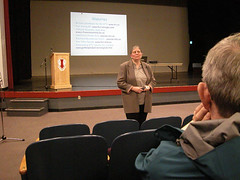
On May 12, BC voters are going to get a second chance to make electoral history here in Canada. Today's picture was taken at a information meeting I attended the other night and it illustrates the biggest problem facing supporters -- no one seems to know about the upcoming vote and no one really seems to care.
Whether its apathy or just lack of awareness is hard to tell. Although the election is less than a couple of months away, there has been very little discussion about BCSTV. Most people seem unaware that the measure is on the ballot again. And that's OK with the folks who would prefer to keep the status quo, which is pretty much all of the elected officials and the party types who surround them. The first past the post system is an adversarial structure that rewards the winners, and is a prize worth fighting for if you're on the winning side. And even if you're not, there's always the hope that you'll take the next round, then your party will be in the driver's seat.
From what I've seen and heard, there are two things happening. First, supporters of the BCSTV process are concerned that counting the votes would be complicated. The people opposed to BCSTV have seized on the complexity issue and intend to make it the debating point. They are warning that it would be too complicated and lead to all kinds of delays on election night and confusion about winners and how they were chosen.
That argument is nonsense, as anyone who has studied the process can attest, including many European countries, as well as New Zealand, that use a STV system to elect their representatives.
Unfortunately, BCSTV supporters are playing along and spend valuable time trying to explain the counting process. But it's not the process that matters - it's the results. The first past the post system we use now regularly results in majority governments that do not refect the majority of votes cast. The BCSTV model would reflect the popular vote and we'd end up with MLAs in numbers that by and large matched the votes their party received.
If you're interested, I'd urge you to visit some of the websites that are online and dedicated to explaining the process, such as:
British Columbians for BC-STV
Fair Voting BC
Fair Vote Canada
Although there weren't that many people at the meeting I attended, there were some good lines that people were encouraged to use when talking to their neighbours.
"The First Past the Post system was invented when we didn't know where the sun went at night!"
Another urged us to adopt a well-known phrase that seemed to work south of the border earlier this year:
"Can we come up with a fairer voting system?"
"Yes we can."
The video below might help those who are interested understand what's going to happen.
Friday, March 27, 2009
Let's stand up for small magazines

I'm writing from The Malahat Review on campus; we've been launching a campaign against the proposed federal cuts to small magazines, which will affect all literary magazines in Canada. I have a poster sized ad that we'll be running in our next issue, and I'm wondering if this could be printed off and put up on your bulletin board, or passed on to students in the creative writing courses? I'll attach it here. Please let me know what I can do with this, if I should forward this to creative writing professors, send hard copies to you, etc.I think we should all send a letter to the Minister and one to our MP. As the poster mentions, you don't even have to put a stamp on the envelope.
Democracy is not easy - it takes work to keep it working.
What really caused the credit crisis
This is a must-read. I've been frustrated by the nagging feeling that the problems that caused the world's economy to melt down aren't as complicated or as unpredictable as the people responsible would like to have us believe. But we keep being told that it "just happened" and that no one could have foreseen the catastrophe it has become.
That's just bull. And in "The Big Takeover" on rollingstone.com, written by Matt Taibbi, we get a sobering look at the real story of what happened and what is continuing to happen. The truth is not unexpected. People with power and influence figured out a way to skirt the regulations and make enormous amounts of money. But what is particularly galling is that we find out that now that their schemes have unravelled, these same people have been able to game the system yet again and are continuing to milk the crisis for their own benefit.
It's a story that will make you very angry. But it's also an exceptional bit of investigative reporting. Taibbi has his own unique writing style and not everyone will appreciate it:
Link to the story
That's just bull. And in "The Big Takeover" on rollingstone.com, written by Matt Taibbi, we get a sobering look at the real story of what happened and what is continuing to happen. The truth is not unexpected. People with power and influence figured out a way to skirt the regulations and make enormous amounts of money. But what is particularly galling is that we find out that now that their schemes have unravelled, these same people have been able to game the system yet again and are continuing to milk the crisis for their own benefit.
It's a story that will make you very angry. But it's also an exceptional bit of investigative reporting. Taibbi has his own unique writing style and not everyone will appreciate it:
It's over — we're officially, royally fucked. No empire can survive being rendered a permanent laughingstock, which is what happened as of a few weeks ago, when the buffoons who have been running things in this country finally went one step too far. It happened when Treasury Secretary Timothy Geithner was forced to admit that he was once again going to have to stuff billions of taxpayer dollars into a dying insurance giant called AIG, itself a profound symbol of our national decline — a corporation that got rich insuring the concrete and steel of American industry in the country's heyday, only to destroy itself chasing phantom fortunes at the Wall Street card tables, like a dissolute nobleman gambling away the family estate in the waning days of the British Empire.It's strong stuff, but Taibbi has the facts to back up his statements. It's a good read.
The latest bailout came as AIG admitted to having just posted the largest quarterly loss in American corporate history — some $61.7 billion. In the final three months of last year, the company lost more than $27 million every hour. That's $465,000 a minute, a yearly income for a median American household every six seconds, roughly $7,750 a second. And all this happened at the end of eight straight years that America devoted to frantically chasing the shadow of a terrorist threat to no avail, eight years spent stopping every citizen at every airport to search every purse, bag, crotch and briefcase for juice boxes and explosive tubes of toothpaste. Yet in the end, our government had no mechanism for searching the balance sheets of companies that held life-or-death power over our society and was unable to spot holes in the national economy the size of Libya (whose entire GDP last year was smaller than AIG's 2008 losses).
So it's time to admit it: We're fools, protagonists in a kind of gruesome comedy about the marriage of greed and stupidity. And the worst part about it is that we're still in denial — we still think this is some kind of unfortunate accident, not something that was created by the group of psychopaths on Wall Street whom we allowed to gang-rape the American Dream.
Link to the story
Thursday, March 26, 2009
Dogs get blamed for everything

The things you see sometimes while you're waiting for a ferry. It seems to me that leashing the dog might not be the most important thing to worry about if people are eating children. But I guess it depends on your priorities.
Wednesday, March 25, 2009
Standing Guard in SGaang Gwaii

Last summer, we spent a week kayaking in Haida Gwaii. It was an unforgettable trip, filled with images and sounds and experiences that were unlike anything I've encountered before. The scenery was spectacular but the visits to the Haida villages, like SGaang Gwaii (Anthony Island/Ninstints), a UNESCO World Heritage Site, were the highlights of the trip. It was powerful and sad at the same time. While there was something elegant about the way that nature is reclaiming these sites, there is a sense of loss as well. All too soon, the evidence of these people will be gone or relegated to recreations and photos. But meanwhile, the watchmen care for the villages, welcoming visitors but keeping the sacred safe. It was a privilege to be invited to participate and I'm grateful we had the chance.
UPDATE - I amended the title of this photo and the location of the village, after reading my notes more carefully.
Video clips from Northern Voice09
I attended NorthernVoice 09, a blogging conference back in February in Vancouver. Since then, a number of the sessions have been posted as videos. You can find a listing of them here.
I'd like to recommend one in particular. Rob Cottingham is a very funny guy, who gave a great keynote address on Saturday. Here's a link to the video (or you can watch a slightly smaller version down below). The jokes come fast and furious, so it may take a couple of viewings to get them all. But it's very good fun.
And if you're interested in technical stuff, Bruce Sharp, the wizard behind lots of cool audio and video software (podcasters will recognize The Levelator) at Singular Software, wrote a post about all the work involved in making the whole thing sound so good. Nice techy stuff...
Enjoy.
I'd like to recommend one in particular. Rob Cottingham is a very funny guy, who gave a great keynote address on Saturday. Here's a link to the video (or you can watch a slightly smaller version down below). The jokes come fast and furious, so it may take a couple of viewings to get them all. But it's very good fun.
And if you're interested in technical stuff, Bruce Sharp, the wizard behind lots of cool audio and video software (podcasters will recognize The Levelator) at Singular Software, wrote a post about all the work involved in making the whole thing sound so good. Nice techy stuff...
Enjoy.
Tuesday, March 24, 2009
Heading down to the ocean
Colquitz creek is a beautiful bit of water that winds its way along the edge of the park near our home. Fresh water flows down from the north, working its way through neighbourhoods, parkland and along roadways winding through Saanich. From where I'm standing on a bridge that spans it at the south end of the park, it's just a short paddle out to Portage Inlet, the large body of water at the end of the Gorge Waterway. The creek here is subject to the large tides we have in Victoria and it changes every day from a flowing river to more of a series of mudflats at low tide. But there's lots of wildlife and it makes for a great paddle. We've seen otters and herons and lots of ducks. People say they've seen seals in the past, but there haven't been any for a long time. It was a great salmon spawning area at one time but that seems to have stopped, at least in the last few years since we've been here. But there are efforts underway to try to bring the salmon back. That would be a pretty amazing sight to see in the middle of the city.

Monday, March 23, 2009
Crossing the finish line
I'm turning the feature photo over to my wife Heather today. She snapped this pic at the end of Jaime's first half-marathon, which she ran on Sunday. The race was in Comox. Jaime had originally planned to run it with her roommate but when she had to pull out, Heather decided to take her up there so she could race it herself. (Jaime, that is, not Heather.)
Jaime said it went better than she had hoped for. She ran the first half at a good pace, but realized at the half-way point that she could go a lot faster. So she spent the second half of the race passing people ahead of her -- great fun for a kid that never gets tired of competing. When she was rowing in high school, she used to race the dump trucks driving along the shoreline in the morning.
This was her first half marathon - in fact, it was her first distance race of any kind. A very impressive first outing. She's already looking forward to the Vancouver half marathon in May. She may have caught that running bug that's going around - fortunately, I've dodged it so far...

Jaime said it went better than she had hoped for. She ran the first half at a good pace, but realized at the half-way point that she could go a lot faster. So she spent the second half of the race passing people ahead of her -- great fun for a kid that never gets tired of competing. When she was rowing in high school, she used to race the dump trucks driving along the shoreline in the morning.
This was her first half marathon - in fact, it was her first distance race of any kind. A very impressive first outing. She's already looking forward to the Vancouver half marathon in May. She may have caught that running bug that's going around - fortunately, I've dodged it so far...
Subscribe to:
Posts (Atom)